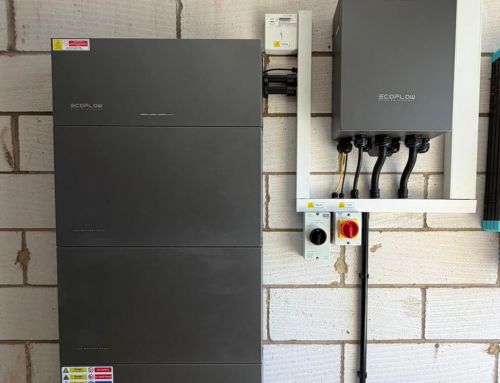
We see hundreds of systems every year, and with the price of panels being so competitive, larger systems are now the norm. This means almost every job we install requires a G99 application.
In the UK, any generation equipment that produces more than 3.68kW of power requires prior permission from the DNO. This is a G99 application, which has a fast-track option for up to 7kW, while systems between 7–50kW undergo a slightly longer process.
As the solar adoption rate grows, more and more of our jobs are being limited – either by inverter size, export limits, or both. Today, I will show you some examples of why these limits might not be as restrictive as you think.
The Example House
Let’s look at an “average” sized job: a house with a large south-facing roof and 18 x 485W panels.
Sizing 101: You don’t need as big an inverter as you might think.
If we took the power of these panels at face value, you would think you need an 8.7kW inverter to accommodate all the power that could be produced. The reality is that the figure given on the datasheet is an STC (Standard Test Conditions) figure. These figures are based on a controlled set of conditions, allowing you to compare panels from different brands to get an idea of how they stack up against each other. However, these are not the expected everyday output rates of the panel. The STC test controls the light input at 1000W/m², and the cell temperature is actively cooled to 25°C.
Today is a lovely, blue-sky day in the UK. Using our irradiance meter, we are currently measuring 832W/m² with an air temperature of 26°C. While this sounds close to the STC figure, note that we are talking about air temperature, not cell temperature. In reality, the panels get warm as the sun covers them in light, and this reduces the output of the panel.
Because of this, most manufacturers include another figure: NOCT. NOCT stands for Nominal Operating Cell Temperature, and it assumes 800W/m² of light, 20°C air temperature (with no active cooling of the cell), and a 1m/s wind speed. The NOCT figure is actually the one to look at when sizing the peak output of your array.
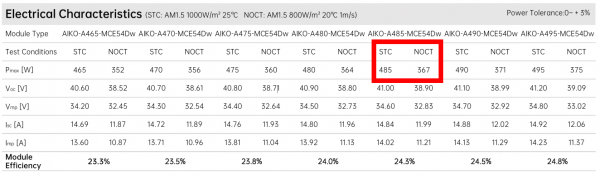
Datasheet showing the different STC and NOCT value
Taking a look at our datasheet, we can see the NOCT figure for our panels is actually 367W, giving us a peak output of 6.6kW. Therefore, pushing for an 8kW or 9kW inverter would be a total waste.
So let’s give our example system a 6kW inverter, bringing the inverter all the way down to 6kW(from 9kW) has only affected the annual total generation by 126kWh, or 1.5% over the entire year. If this lost generation was entirely exported, the “lost” income over the year would only be around £10–£15.
This is further complicated by hybrid systems. With a battery, the inverter can actually process more than its rated power. This is because the inverter’s power rating is a measure of its AC power – the power the house or grid will use. If a 6kW system is receiving 7kW of solar power, but the battery isn’t full, it can bypass the AC conversion and send that extra power directly to the battery as DC.
Oversizing: It’s still worth installing as many panels as you can.
While the inverter shouldn’t be larger than necessary, there are advantages to having more collector space for non-peak times because in the winter, no panel will be at its peak output. Imagine solar panels like buckets collecting rain: if each bucket only gets 50% full, having more buckets still gives you more total water collected. The same is true for solar. Winter is when solar generation is needed most, as your household energy demands are typically higher.
DNO Limits
Let’s bring it back to our example house: 18 x 485W panels (8.7kWp of STC solar) paired with a 6kW inverter and 15kWh of battery storage. Because it will become important later, I’m going to assume a moderate energy usage for this property of 6000kWh per year.
Example 1: No Limitation
Let’s see what the figures look like for this property with no DNO restrictions:
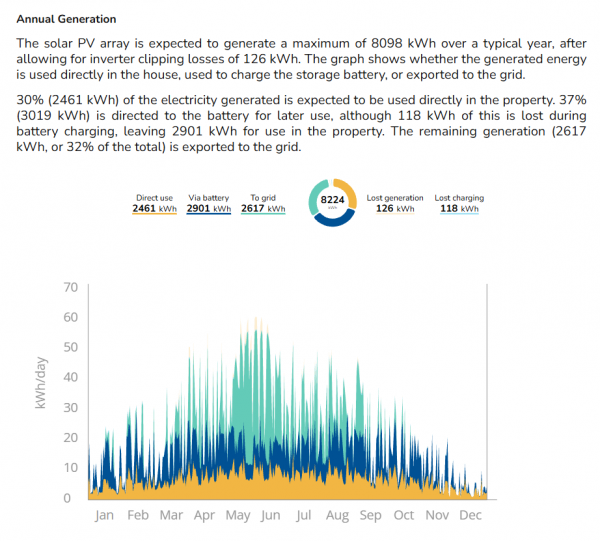
Annual Generation Example
The system would generate around 8100kWh per year, with the house’s consumption split as follows:
- 2461kWh of solar used directly.
- 2798kWh used via the battery. (This is slightly lower than above, as our model will account for losses in the charging/discharging as it’s not 100% efficient).
- 2741kWh coming from the grid.
This means around 66% of the usage is covered by the hybrid system. On top of that, another 2617kWh would be exported to the grid. Accurate to today (May 2026), that would equate to a saving of £1649 in year one (a £1335 bill reduction, along with £314 in export payments). Not bad!
Example 2: 3kW Export Limit
Now let’s look at an export-limited system. Imagine the DNO came back with a strict 3kW restriction. Our instinct is to assume this would halve the export, but that isn’t really the case. In reality, there is only a small part of the day where the system is a) covering all house loads, b) the battery is completely full, and c) there is still more than 3kW left over to export. Let’s look at how that actually plays out:
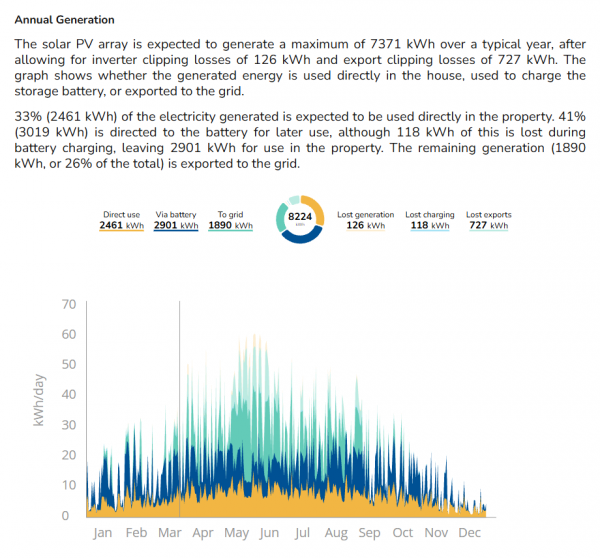
3kW Export Limited System Example
With our 3kW export limit, our system now produces 7371kWh per year. Because this limit only affects export, the home’s bill savings and consumption stay exactly the same at 66%. We would, however, lose 727kWh in export, bringing our total export down to 1890kWh per year.
Financially, that brings our year-one saving to £1458 – only about an 8% reduction. In terms of ROI, this changes the expected payback period from 9 years to 10 years. This is with the export halved, and shows that the peak figure is not as critical as it appears initially.
However, there is a simple solution to this: additional battery capacity.
If we added another 5kWh of battery storage to this system, the year-one saving jumps back up to £1598, even with the 3kW export limit in place. This is because the “lost” export can instead be captured by the battery, and offsetting your import rates saves you much more money than selling back via export rates. Obviously, there is slightly more capital expenditure at the front end, but from a payback perspective, you remain neutral while increasing your grid independence.
Conclusion
Ultimately, receiving a DNO export restriction or stepping down to a smaller inverter shouldn’t be a cause for concern. As the numbers show, real-world solar generation relies far more on NOCT rather than peak STC conditions, and any restricted export can be highly mitigated with the right battery storage strategy.
At Solr, we focus on designing systems tailored to your actual household consumption rather than just chasing numbers. By prioritizing smart battery integration and realistic generation data, we ensure you get the best possible return on investment and maximum grid independence, regardless of network limitations. We even have the capability to use your actual smart meter data, giving you highly accurate modelling and predictions. If you are considering a larger array but have concerns about G99 restrictions, we can run the real-world numbers for your specific property. Feel free to Contact us with your details.